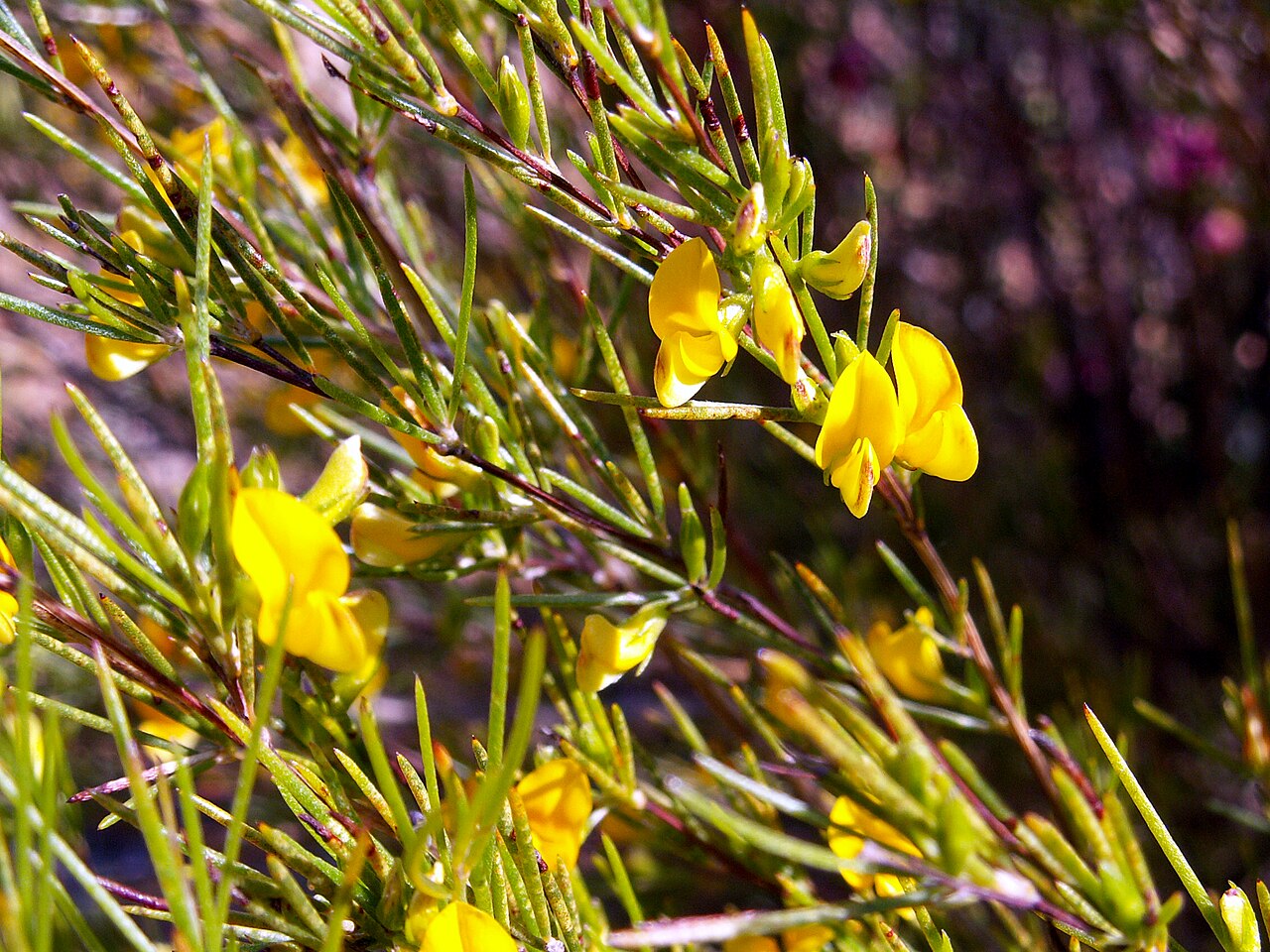
Rooibos grows commercially nowhere else on earth — only in this corner of the Western Cape, and the Cederberg around Citrusdal and Clanwilliam is its heartland. This page covers what the plant actually is, why it will not grow anywhere else, what the industry looks like today, and how to go and stand in a field of it.
What rooibos actually is
Rooibos is Aspalathus linearis, a shrub of the fynbos — the fine-leaved vegetation that covers the mountains of the Western Cape. It is a legume, related to peas and lupins, not to the tea plant. Up close it looks nothing like a tea bush: thin woody stems carrying dense, needle-like green leaves, with small yellow flowers in spring.
What is harvested is the leaf and the fine stem, cut in summer, bruised and dried. Brewed, it is sweet and slightly woody, with none of the astringency of black tea, and it is naturally caffeine-free — nothing is removed to make it so.
The bush is not red
This is the part that surprises most people who see a farm for the first time. A rooibos field is green. The red comes later: after cutting, the leaf is bruised and left to oxidise, and it is that oxidation — the same broad process that turns a cut apple brown — which takes it from green to the deep red-brown in the cup. Skip the oxidation and dry the leaf straight away and you get green rooibos: the same plant, lighter and grassier in the cup, sold as a separate product.
We describe the plant, the place and the process only. This page makes no claims about health or benefits of any kind — that is not something we are qualified to write.
Why only here
Rooibos is fussy in a very specific way. It is adapted to the acidic, sandy, nutrient-poor soils of the Cederberg and the Mediterranean climate that goes with them — wet winters and hot, dry summers, with the mountains shaping both the rainfall and the temperature swing between night and day. Take the plant out of that combination and it does not perform commercially, which is why every attempt to farm it elsewhere has stayed an attempt.
The result is a crop tied to one landscape as tightly as any wine region. The European Union formalised exactly that in 2021, granting rooibos protected designation of origin status — the same class of protection that reserves the name Champagne or Parma ham for a defined place.
More than 90% of South Africa's rooibos comes from the Cederberg. The mountains that do this are the ones on the eastern skyline from town — see the Cederberg from Citrusdal for what else is up there.
Citrusdal is one corner of the growing region, not the whole of it: rooibos country runs north through the Cederberg and up onto the Suid–Bokkeveld escarpment. We cover that wider region on our sister guide, Visit Rooibos Country — the farms you can visit, the co-operatives, and the plant's own story.
Source: Bizcommunity for the EU protected designation of origin (2021).
The industry in numbers
Sources: Bizcommunity, February 2026 for export figures and markets; rooibos industry sources for the Cederberg share, as used on our fruit and rooibos page.
Indonesia, Sri Lanka and China are named as growing markets. Almost all of that volume leaves the country in bulk, which is the quiet economic point behind the tourism ambition below: the valley grows the thing the world buys, and sees very little of the buyer.
Rooibos is going to space
Rooibos seeds are scheduled to travel to the International Space Station in October 2026. The project involves the South African Rooibos Council, the space-education company MaxIQ Space and the South African National Space Agency, with seven Cederberg schools and Parklands College taking part.
The experiment itself is simple to state: find out what microgravity and cosmic radiation do to rooibos seed. Seeds flown to the station are compared against control samples kept on the ground, and germination and growth are measured once they come back.
The second half of the project is tourism research, led by Prof. Martinette Kruger of North-West University's TREES research unit, with Curtin University in Australia collaborating. In February 2026 students from both universities visited the Cederberg to work on tourism products. Kruger's framing is that "rooibos is much more than a beverage; it is a destination brand because it can only be produced in one small part of the world", and that "rooibos could do for the Cederberg what wine has done for the Cape Winelands" — while being clear that "tourism should not replace farming; it should add value to it". The stated obstacle is a web problem more than a farming one: "the challenge is ensuring that every international media story points people back to the Cederberg".
If you want to do something about that as a visitor, there is one useful answer, and it is the next section: come and walk a rooibos farm.
Launch dates move. October 2026 is scheduled, not certain, and the same goes for everything downstream of it. The permanent "Rooibos to Space" interpretation centre in Clanwilliam is proposed — it does not exist, and there is nothing to go and see.
Visit Citrusdal has no involvement in the mission and no connection to the South African Rooibos Council, MaxIQ Space or the universities. We are reporting a published story from the outside.
Source for this whole section: Bizcommunity, "Rooibos space mission could put Cederberg tourism on the global map".
This section was written in August 2026 and describes a scheduled future event. Check a current source before relying on the date.
Visiting a rooibos farm
A rooibos farm is not a winelands estate, and that is most of the appeal. The fields sit high and open with the Cederberg behind them, the bushes in rows on sand, and the work is visible: cutting in summer, then the bruised leaf spread out in the sun to turn colour. A tour usually means the field, the drying and sorting, and a tasting that puts red and green side by side so the difference stops being an abstraction.
Carmién Tea Rooibos Farm
The rooibos farm at De Tol, on the Citrusdal side of the valley. Contact the farm directly to arrange a visit.
See the listing → Producer profileCarmién Tea
Rooibos grower, blender and bulk exporter, founded 1998 on the historic Brakfontein Estate. Fairtrade, Rainforest Alliance, organic and BRCGS certified.
Read the profile → Producer profileMouton Citrus
Citrus and rooibos side by side at Brakfontein Landgoed. All own production Fairtrade accredited; rooibos certified organic by Ecocert.
Read the profile → Stay · CederbergJamaka Organic Farm
A certified organic citrus, mango and rooibos farm with self-catering cottages and riverside camping, if you would rather sleep on one.
See the listing →These are the rooibos-related places we hold sourced information for. Visits are generally by arrangement, not walk-in, and we publish no prices or opening hours because we hold no verified source for them — phone the farm first. More options on things to do.
When to come
Rooibos is harvested in summer, so a visit in the hot months is the one most likely to put cutting and drying in front of you. Summer in this valley is genuinely hot and dry; the trade-off is that it is also the best season for the Cederberg's swimming holes. Exact harvest weeks move with the season, so ask the farm rather than trusting a month.
Spring is the other good answer: the bushes carry their small yellow flowers, and the West Coast wildflower season is on. Season by season, including weather averages, is on when to visit.
| Harvest | Summer — exact weeks vary by season and farm |
|---|---|
| Flowering | Spring, small yellow flowers on the bush |
| Where the farms are | The Cederberg around Citrusdal and Clanwilliam, about two hours north of Cape Town on the N7 |
| Arranging a visit | Contact the farm directly; tours are usually by appointment |
Common questions about rooibos
What is rooibos?
A drink made from the leaves and fine stems of Aspalathus linearis, a fynbos shrub native to the Cederberg. Not related to the tea plant, and naturally caffeine-free.
Where does rooibos grow?
In the Cederberg and the surrounding Western Cape, with Citrusdal and Clanwilliam at the centre of it. More than 90% of South Africa's rooibos comes from the Cederberg, and it grows commercially nowhere else on earth.
Why does rooibos only grow in South Africa?
It needs acidic, sandy, nutrient-poor mountain soil and a climate of wet winters and hot dry summers. Commercial attempts elsewhere have not worked, and the EU recognised the tie between product and place with a protected designation of origin in 2021.
Is rooibos a real tea?
Not botanically. Tea is Camellia sinensis; rooibos is a legume-family fynbos shrub. It is brewed like tea, which is why it is sold as one.
Does rooibos have caffeine?
No — it is naturally caffeine-free, with nothing removed to make it so.
What is the difference between red and green rooibos?
The same plant, handled differently after cutting. Red is oxidised, which gives the colour and the sweet woody flavour; green is dried straight away and tastes lighter and grassier.
Can you visit a rooibos farm?
Yes — several farms around Citrusdal and Clanwilliam run tours and tastings, usually by arrangement. Start with Carmién Tea's rooibos farm.
Why are rooibos seeds going to space?
To test what microgravity and cosmic radiation do to germination and growth, in a project involving the South African Rooibos Council, MaxIQ Space and the South African National Space Agency, scheduled for October 2026. We have no involvement in it.
Last updated August 2026 · every figure on this page is sourced · no health claims, prices or opening hours are stated.