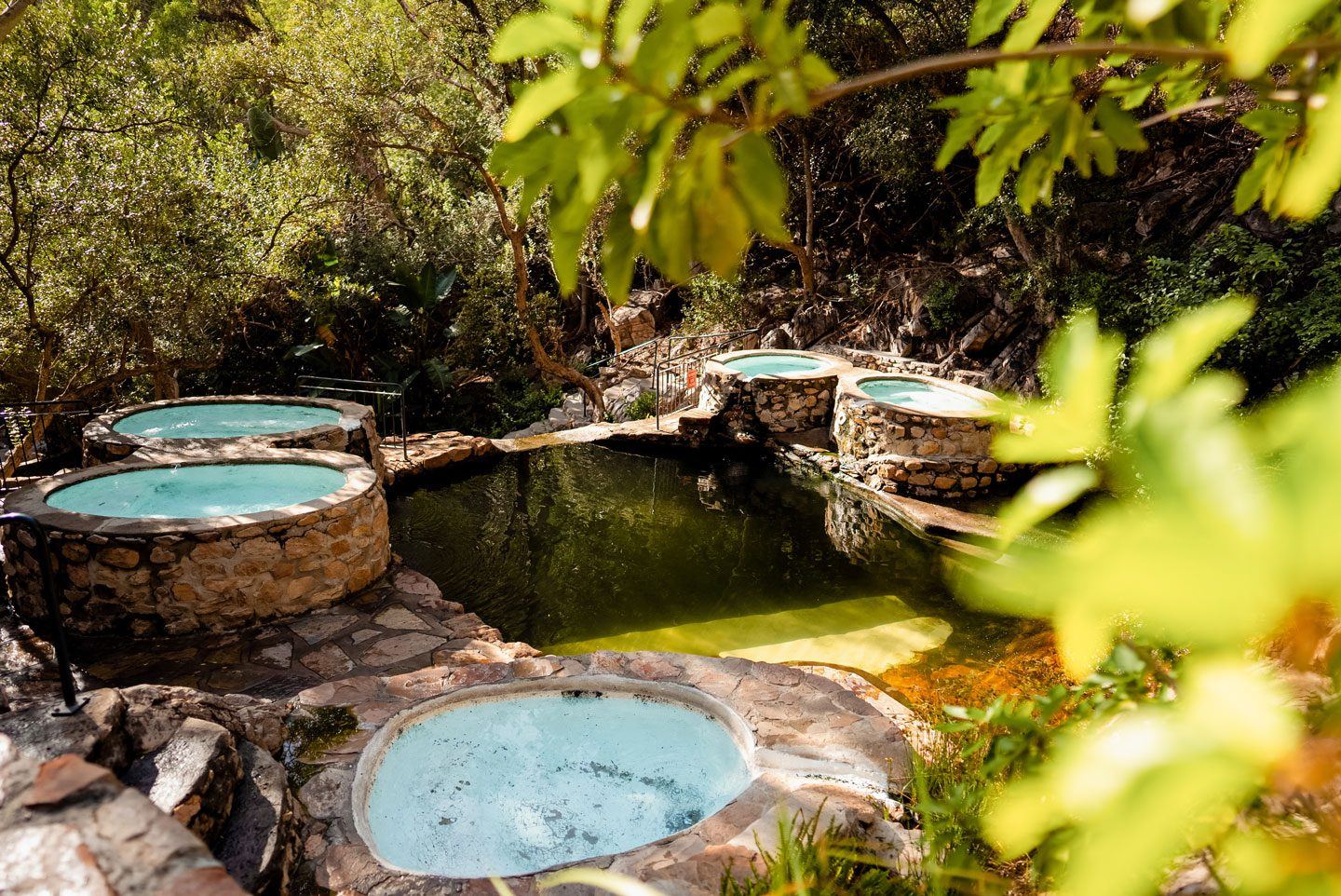
The Baths is a natural mineral hot spring near Citrusdal where the water comes out of the mountain at 43 °C — and has done, at about 105 000 litres an hour, since it was first written down in 1739. It sits on a citrus farm about 18 km south of town, about two and a half hours north of Cape Town.
How hot is the water?
The spring emerges from the mountain at a constant 43 °C (109 °F), flowing at roughly 105 000 litres every hour — the same today as three centuries ago. There is a hot pool and a cooler pool for when you have had enough of the heat, along with natural rock pools and private baths fed by the same mineral water.

Warm baths, hot baths, hot springs — same place
People search for this spring under half a dozen names, and every one of them leads to the same place. The Baths, the Citrusdal warm baths, the Citrusdal hot baths and the Citrusdal hot springs are all the same water on the same farm, 18 km south of town. Afrikaans speakers usually call it die warmbad.
One genuine confusion worth heading off: this is not Warmbaths in Limpopo, the resort town renamed Bela-Bela, which sits about 1 400 km away on the other side of the country. If you are driving from Cape Town, Citrusdal is the one you want.
Are the Citrusdal hot springs worth visiting?
It depends what you are picturing. If you want a quiet soak in genuinely natural mineral water on a working citrus farm, with the Cederberg above you and not much to do beyond that — then yes, this is one of the oldest and best of its kind in the country.
If you are picturing a modern spa with treatments, slides and a day-visitor gate, adjust your expectations. The Baths is deliberately old-fashioned: self-catering units, a farm setting, and a booking system that runs on the telephone. That is the appeal for most people who go back, and the disappointment for the few who arrive expecting a resort.
Is there a day pass for the Citrusdal warm baths?
No. This is the question most people get wrong: The Baths does not take day visitors at all. The resort states it plainly — “No day visitors are allowed” — on its home page, its rates page and its rules page. There is no gate to pay at, no day ticket, and no arrangement to be made by email. The only way to use the springs is to book a chalet, flat or campsite and stay over.
Do not drive to The Baths hoping to talk your way in for an afternoon — it is a working citrus farm with managed access, and the answer is no. Book a night, or plan a different day out in the valley.
Day-visitor rule per the operator: policies & rules and rates, read 17 August 2026.
The Baths price list — what it costs
Rates are set by the resort and change season to season, so treat these as a guide and confirm the current price when you book. The figures below are the resort’s own published tariff for March 2026 to February 2027, and every price on this page is in South African rand (ZAR).
| Camping & caravan sites | R225 per person midweek, R275 per person over weekends |
|---|---|
| Flats (2 guests) | From R1 600 midweek, R1 900 over weekends, per unit |
| Olsen House with jacuzzi (2 guests) | From R1 700 midweek, R2 000 over weekends, per unit |
| Chalets (2 guests) | From R1 900 midweek, R2 300 over weekends, per unit |
| Larger units (4–6 guests) | R2 000 – R4 500 per unit, depending on size and night |
| Weekends | Two-night minimum; long weekends three to four nights |
| Check in / out | Arrive from 14h00, vacate by 10h00 |
| Cancellation | Non-refundable within 14 days, plus a 20% admin fee |
The Baths camping rates
Camping and caravan sites are R225 per person per night midweek and R275 per person over weekends on the March 2026 – February 2027 tariff. Camping is charged per person; every other unit is charged per unit, so a chalet costs the same whether two or four of you are in it, up to its limit — which means a family of four camping pays four times the nightly rate, and often more than a flat.
The Baths specials — are there seasonal discounts?
The resort publishes one tariff a year — currently March 2026 to February 2027 — and it does not advertise seasonal discounts, off-season specials or package deals. The only price difference built into the tariff is midweek versus weekend: Monday to Thursday nights are cheaper on every unit type, and that is the discount. If you see a “special” for The Baths on a third-party booking site, check it against the operator’s own rates page before you pay.
See the current rates at thebaths.co.zaTariff published by the operator for March 2026 – February 2027 — thebaths.co.za/rates, read 17 August 2026. We are not the resort and cannot quote or hold a price.
When is it quietest?
Midweek, out of school holidays. The resort charges roughly R50–R400 less per night from Monday to Thursday than over a weekend, and weekends carry a two-night minimum — so the cheapest and the emptiest nights are the same nights. Weekends, long weekends and the Western Cape school holidays are the busiest, and the resort takes bookings up to six months ahead, which tells you how far in advance the popular dates go.
Season matters less than you would expect: the spring runs at 43 °C all year, so a cold wet July afternoon is arguably the best time to be in it. Summer days in the valley regularly pass 35 °C, which makes a hot pool a harder sell. More on when to visit ›
What is there to do besides the springs?
Facilities per thebaths.co.za and SA-Venues.
Facilities for campers
The 25 camping and caravan sites are shaded, have power points, and share ablution blocks with hot water. Campers use the same pools, rock pools and private baths as the chalet and flat guests — there is no separate or lesser access. Sites are charged per person, so a family of four pays four times the nightly rate.
Facilities for day visitors
There are none, because there are no day visitors. The resort has no day-visitor gate, no day tariff, no picnic area for non-residents and no arrangement that can be made in advance. Every facility on this page requires an overnight booking. This is the most common wrong assumption about The Baths, and it is why people drive two and a half hours and get turned around.

Where can you stay at The Baths?
The springs sit within a self-catering resort with three kinds of accommodation, all with kitchens and braai areas:
| Chalets | 16 self-contained units |
|---|---|
| Flats | 19 self-contained units |
| Camping & caravan sites | 25 shaded sites with power and ablutions |
Unit counts from thebaths.co.za.
How do you book?
Bookings are made by telephone only on +27 22 921 2141 or +27 22 921 2174 (email enquiries welcome, but the booking itself is by phone). A few things worth knowing before you call:
- Weekends require both Friday and Saturday nights
- Long weekends require three to four nights
- Bookings open up to six months ahead
- Some units can be booked online; others by phone
Booking details per the operator, thebaths.co.za. Availability opens on the resort’s own booking page, not ours.
What if The Baths is fully booked?
It often is. Weekends, long weekends and school holidays at The Baths are usually booked out months in advance — the resort opens bookings six months ahead, and the popular dates go early. If you want a Friday and Saturday in season, phone the moment you know your dates.
If it is full, you can still come to the valley. There is no day visit to the springs, so you will not be soaking in the 43 °C water, but there are other places to stay within a short drive, several with a pool or a hot tub of their own:
Facilities per each establishment’s own website, read 15 September 2026. Confirm availability and what is on offer with them directly.
A spring older than the town
The San used this water for thousands of years before it appeared in a colonial ledger in 1739. Governor Rijk Tulbagh had proper bathhouses built here in 1763, and the Scottish McGregor family ran The Baths from 1903 until 2015. The town of Citrusdal itself only arrived in 1916 — a latecomer to its own hot spring.
Read the full history of CitrusdalCitrusdal hot springs — quick questions
How hot is the water at The Baths?
43 °C (109 °F), flowing at about 105 000 litres per hour. There is a hot pool and a cooler pool.
Is there a day pass?
No. There is no day pass and no day ticket — the resort takes no day visitors at all, so you have to book a night to use the springs.
What does it cost?
On the resort's 2026/27 tariff, camping is R225 per person midweek and R275 over weekends; units run from about R1 600 to R4 500 per unit per night. Check the current rates.
What if The Baths is fully booked?
Popular dates are usually booked out months ahead. There is no day visit, so stay nearby instead: the options are above.
How far is it from Cape Town?
194 km in total, about two and a half hours: 176 km north on the N7 to Citrusdal, then 18 km south on The Baths Road.
Are the warm baths and The Baths the same thing?
Yes — warm baths, hot baths, hot springs and The Baths all mean this spring. It is not Warmbaths (Bela-Bela) in Limpopo.
Is it worth visiting?
For a natural mineral soak in a farm setting, yes. For a modern spa or a day-visit waterpark, no — it is not that kind of place.
Last updated July 2026 · sources cited throughout