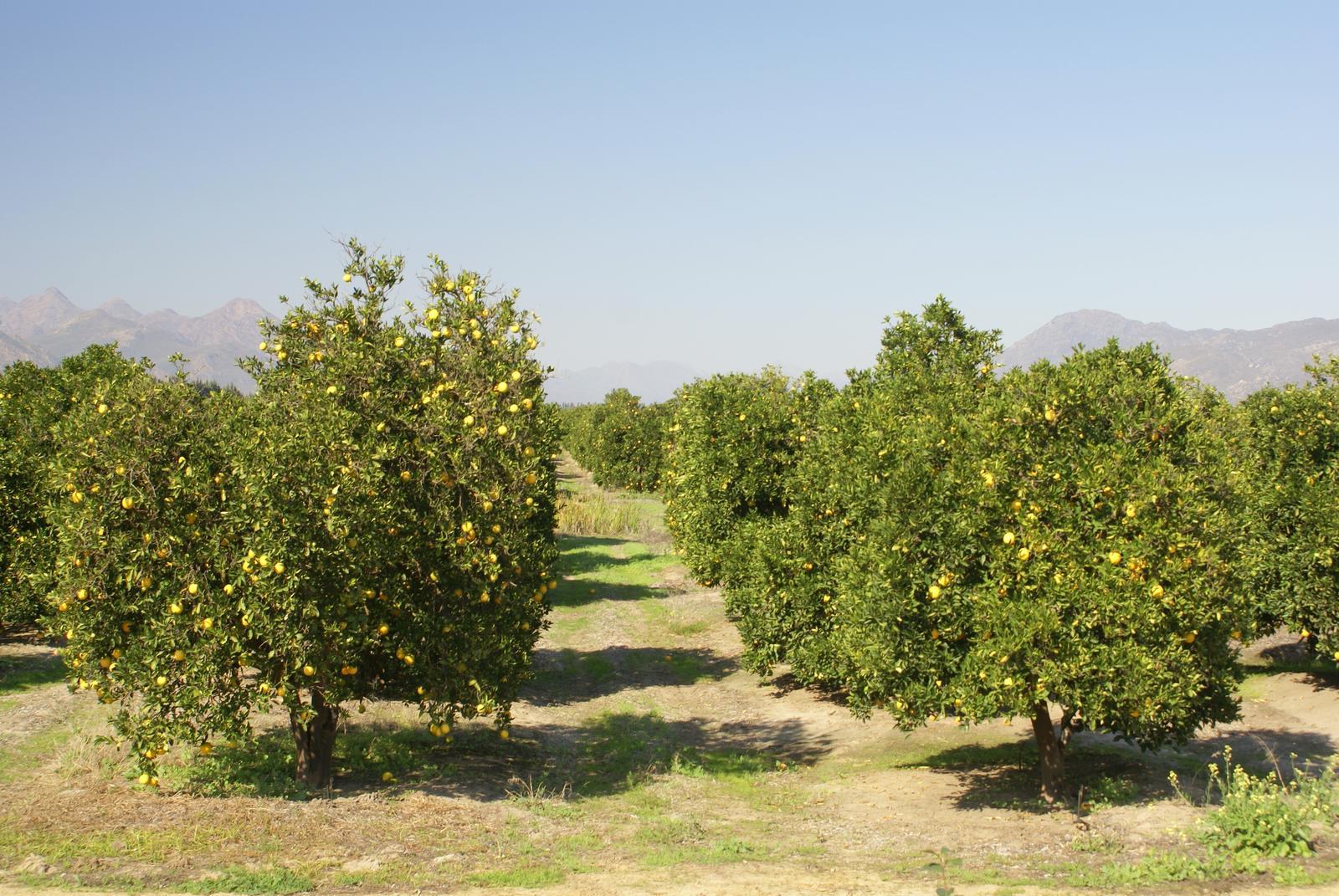
Where it is
Citrusdal sits in the Olifants River valley in the Western Cape of South Africa, on the N7 roughly 170 km north of Cape Town, enclosed by the Cederberg range. The town is at about 32.59°S, 19.01°E. The valley floor is the growing area — orchards run along the river with mountains on either side.
Its export port is Cape Town. We publish no transit times, sailing schedules or terminal conditions: those move week to week and your forwarder will have current numbers.
The scale of the area
| Measure | Figure |
|---|---|
| Position nationally | Centre of South Africa's third-largest citrus-producing area |
| Share of the national crop | Roughly 14% |
| Farmers in the area | About 200 |
| Best known for | Navel and Valencia oranges. The wider Olifants River valley is the traditional home of South African soft citrus and grapefruit |
| Seasonal workforce | Roughly 6 000 people harvesting, sorting and packing |
| Harvest and packing | March – September |
Sources: southafrica.co.za "Farming in Citrusdal"; Farmer's Weekly SA.
Why citrus does well here
The valley has a Mediterranean climate — wet winters, hot dry summers. Two consequences matter commercially. Dry summers mean lower fungal disease pressure while the fruit is developing. And cool winter nights drive rind colour: colour break in citrus is a response to cold, not a sign of ripeness, which is why growing regions without a cold period struggle to get there naturally and why this valley is associated with well-coloured navels.
The mountains do double duty — they shelter the valley and they feed the water.
Water
Irrigation comes off the Olifants River system, fed from the Cederberg catchment. Water security is a standard due-diligence question for South African produce and a fair one to put to any grower.
The harvest window
The valley harvests and packs from about March through September. South Africa's winter is the northern hemisphere's summer, so that fruit lands counter-seasonally in Europe, North America and Asia. That gap is the entire commercial basis of the trade.
Indicative cultivar-by-cultivar windows are on the season tracker.
Who grows, packs and exports
Four operations in and around the valley publish enough about themselves to profile responsibly. They are not the only ones, and appearing here is not a recommendation — we hold no commercial relationship with any of them and take no payment for placement.
Certifications, and what each one actually answers
These are the schemes that come up in South African citrus. What a particular producer holds sits on that producer's own page, and only where they publish it themselves. Certifications lapse and get re-audited — treat every claim as needing a current certificate with dates on it.
| Scheme | What it covers | Usually asked for by |
|---|---|---|
| GlobalGAP | Good agricultural practice at farm level: food safety, traceability, worker welfare, environment | The baseline for most EU and UK retail |
| SIZA | Sustainability Initiative of South Africa — the local ethical and environmental audit programme | European buyers doing social-compliance due diligence |
| BRCGS | Food safety at the packhouse or processing site | Retailers, own-brand packing |
| Fairtrade (FLO) | Social and economic standard, with a premium paid to the producer | Buyers running an ethical range |
| Rainforest Alliance | Environmental and social certification | Retail sustainability programmes |
| Organic (EU / USDA NOP / JAS) | Production method. Certified separately for each destination regime | Organic buyers in each market |
A certificate tells you a system was audited on a date. It is not a residue result and it is not a specification — see how MRLs work.
Route to market
Fruit is picked in the valley, packed locally, and moves by road to Cape Town for export. From there the counter-seasonal programmes run. Summer Citrus from South Africa ships Western Cape citrus into the United States, entering mainly at Philadelphia and duty-free under AGOA. That programme is Western Cape-wide rather than Citrusdal-only, and growers here form a significant part of it.
Who carries cost and risk at each step of that journey is what Incoterms decide — and getting it wrong is the most common expensive mistake on a first shipment.
What to ask a producer
The things a supplier file needs that only the grower can answer:
- Current certificates with issue and expiry dates — not just a list of scheme names
- Which cultivars, and the realistic window for them this season
- Pack-out capacity, and whether packing is own-site or third-party
- Water source, allocation, and current restriction status
- The residue programme, and which markets it is built to satisfy
- Traceability: how far back a carton traces, and how quickly
- Cold chain from packhouse to vessel, and who controls each leg
- Labour: permanent versus seasonal, housing, and SIZA or equivalent audit status
- Which markets they are already approved for and actively shipping to
- Their preferred Incoterm, and who arranges pre-shipment inspection